
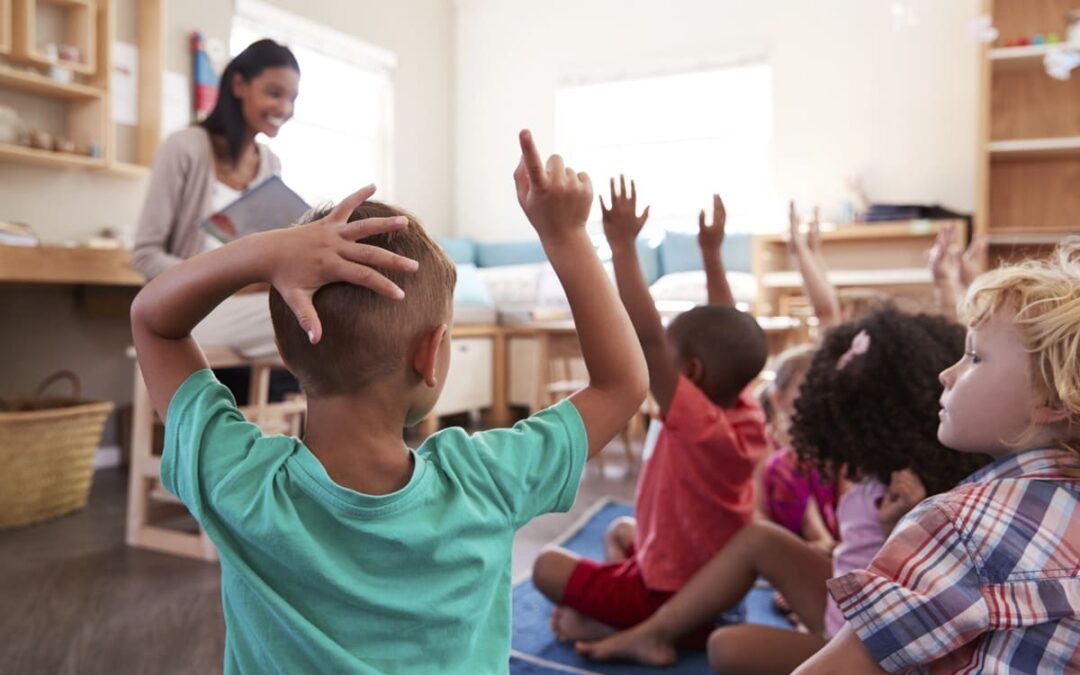
Early years education forms the foundation for a child’s cognitive, social, and emotional development.
While past approaches often concentrated on memorisation and rote learning of data, current research and progressive curriculum highlight the importance of problem-solving skills.
To understand this shift, parents must research Ajman schools, CBSE curriculum schools in Ajman, and Indian CBSE schools in Ajman to make informed educational judgements.
The benefits of problem-solving over memorisation are discussed in this essay, along with the reasons it is important in early infancy and potential applications.
Core Difference
1. Understanding the Difference Between Memorisation and Problem-Solving
Memorisation is the ability to recall information, such as letters, numbers, or facts, without necessarily understanding it.
On the other hand, solving problems requires using reasoning, creativity, and critical thinking to find solutions. It teaches children how to think as well as what to memorise.
| Aspect | Memorisation | Problem-Solving |
|---|---|---|
| Focus | Recall Facts | Apply Knowledge Creatively |
| Skilled Developed | Short-Term Memory | Critical Thinking, Reasoning |
| Engagement | Low, Repetitive | High, Interactive |
| Real-World Relevance | Limited | High, Transferable Skills |
Cognitive Development
2. Cognitive Benefits of Problem-Solving
Solving problems stimulates several brain regions at once, promoting the growth of executive processes that are essential for learning:
Working Memory
Retaining and manipulating information while completing tasks.
Cognitive Flexibility
Adapting to new problems and perspectives.
Control of Inhibition
Controlling impulsive behaviour and making thoughtful decisions.
Early problem-solving exercises enhance these abilities more successfully than rote memorisation, according to research (Diamond, 2013). Youngsters who acquire these skills early on are better equipped to handle difficulties in subsequent grades and in life.
Real-World Learning
3. Learning and Real Life Are Connected through Problem-Solving
Solving problems turns classroom instruction into real-world, worthwhile experiences. In early years classrooms, this can include:
Exploratory Science
Knowing what items float or sink and why plants grow towards light.
Mathematical Reasoning
Sorting, measuring, and solving puzzles with blocks or manipulatives.
Solving Social Issues
In group play, resolving conflicts or negotiating turn-taking.
These exercises enable children to apply their knowledge rather than merely recall facts for the CBSE curriculum schools in Ajman, which place a strong focus on inquiry-based learning and experiential learning.
Confidence & Creativity
4. Promoting Self-Belief, Adaptability, and Originality
Youngsters who are good at problem-solving are more likely to accept challenges and view mistakes as teaching opportunities.
- Youngsters experiment with several options, evaluate the outcomes, and refine their approach.
- By enduring hardships, they develop resilience.
- Their ability to generate multiple solutions to a single problem encourages creativity.
However, memorisation does not foster innovation or independent thought; it just rewards right responses.
Social-Emotional Skills
5. Improving Emotional and Social Growth
Solving problems outside of the classroom fosters the growth of critical social-emotional abilities:
These abilities are essential for fostering inclusive and supportive learning environments in Ajman’s multicultural classrooms.
Classroom Examples
6. Useful Illustrations from Ajman’s Early Years Classrooms
Numerous Indian CBSE schools and CBSE curriculum schools in Ajman employ methodical and innovative approaches to problem-solving:
Discovery Corners
Through experiments with materials like sand, water, and blocks, children investigate concepts of physics, measurement, and patterns.
Project-Based Learning
Language, math, science, and collaboration are all integrated while creating a school tale or creating a miniature garden.
Simulations & Role Playing
Social negotiation, empathy, and decision-making are all taught through role-playing real-world situations, such as a post office or marketplace.
Open-Ended Math & Logic Tasks
Playing games with patterns, puzzles, and manipulatives promotes critical thinking and original solutions.
These exercises have been shown to improve social-emotional and cognitive development and are consistent with CBSE’s constructivist and inquiry-based frameworks.
Evidence
7. Proof from International Practices and Research
According to longitudinal studies, kids who are exposed to problem-solving at a young age exhibit:
- Improved elementary school reading and numeracy scores
- Enhanced originality and critical thinking
- Increased emotional control and resilience
According to the OECD (2019) and NAEYC (2020), students who participate in curricula that emphasise inquiry and problem-solving perform better than their counterparts who are taught primarily through memorisation.
Reflective, hands-on experiences from the foundational years are now highly valued in the CBSE framework, which encourages “learning by doing.”
Final Thoughts
Final Thoughts
In the early years, problem-solving is crucial for general development, even though memorisation is still an excellent technique to acquire the basics.
Children are better prepared for obstacles in school, life, and the future through the development of social-emotional skills, creativity, resilience, and cognitive flexibility.
Parents should give preference to Ajman schools that incorporate problem-solving techniques into early childhood education, especially those that follow the CBSE curriculum, while evaluating them.
Instead of merely learning information, this will ensure that kids develop their ability to think, create, and grow. These days, encouraging children to think critically ought to take precedence over just memorising facts.

